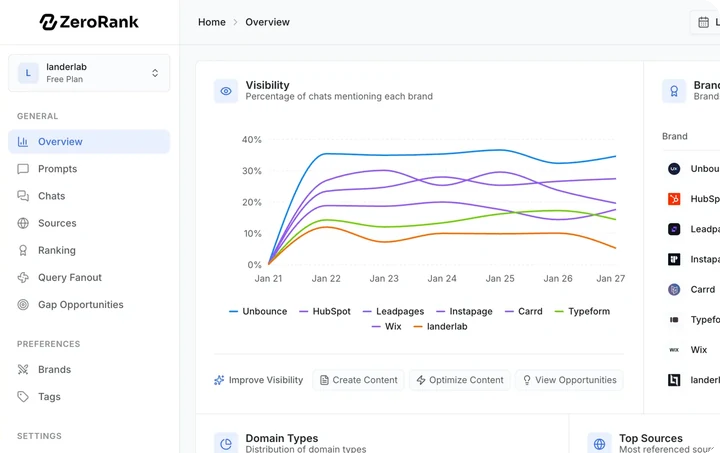
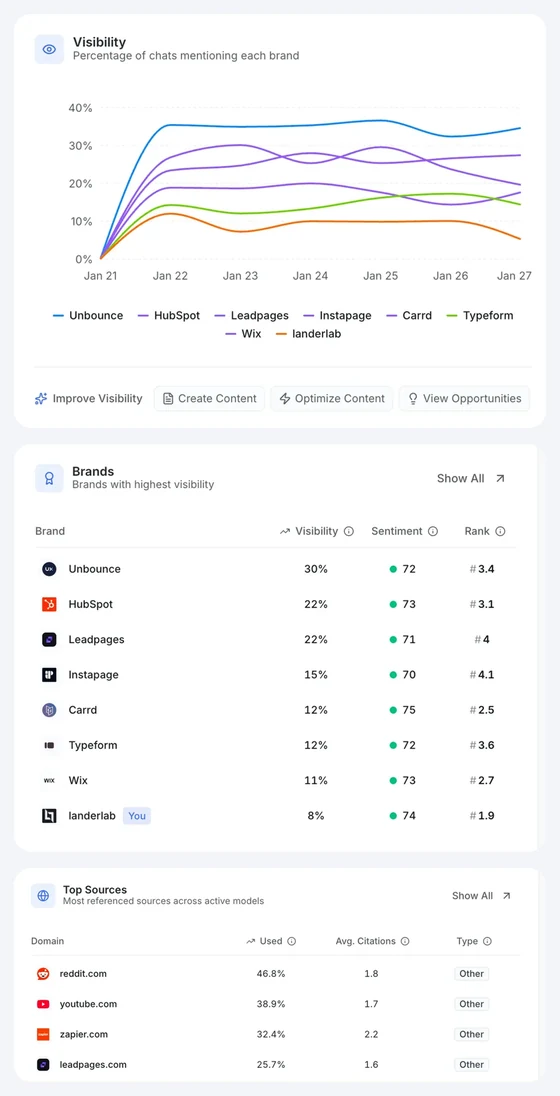
8 Best AI Search Monitoring Tools: Features & Pricing (2026)
Compare the best AI search monitoring tools for tracking brand mentions, rankings, citations, sentiment, and competitors across ChatGPT, Gemini, Perplexity, Claude, Google AI Overviews, and other platforms.

Key Takeaways
- AI search monitoring tools show whether your brand appears in answers, which competitors are recommended and which source pages are linked.
- Compare the platforms included in the plan you would actually buy, along with questions, markets and tracking frequency.
- Prompts, answers and credits are different limits. Estimate the work your question set will use before comparing headline prices.
- Several tools now offer recommendations, agents or content workflows. Test the next task you need to complete, not just the dashboard.
- Free trials, limited free allowances and ongoing subscriptions are different offers. Check the currency, billing term and add-ons.
Your brand may appear prominently in ChatGPT but be absent from Google AI Overviews, Perplexity, or Gemini. It may also rank first for one buying prompt and disappear when the same question is phrased differently.
AI search monitoring tools help you track these variations at scale. They repeatedly run the prompts that matter to your business and measure:
- How frequently your brand is mentioned
- Where it ranks among recommended companies
- Which competitors appear more often
- How AI platforms describe your brand
- Which domains and pages they cite
- How these results change over time
Most tools provide some version of these metrics. The bigger difference is how much monitoring you receive for the advertised price.
Some plans cover only a selected set of AI platforms. Others let you choose several models, charge for each additional engine, or use credits that decrease faster as you expand your tracking. A tool may advertise support for ten platforms while reserving most of them for Enterprise.
In this guide, we compare the best AI search monitoring tools based on their monitoring capabilities, platform coverage, pricing structure, and ability to help you act on the data.
Best AI search monitoring tools at a glance
Tool | Useful fit | Starting price | Main capacity check |
ZeroRank | Tracking plus content and optimization work | Starter $39/month | 2,400 answer-budget units; premium models use more |
Profound | Enterprise insights and marketing agents | Brand trial free for 7 days; Enterprise custom | 50 recommended questions across 3 engines during the trial |
Peec | Daily tracking, source analysis and agent actions | Starter €85/month | 50 questions, three selected models and one project |
Otterly | A small daily question set | Lite $29/month | 15 questions; 4 engines; others are add-ons |
AthenaHQ | Testing a credit-based platform | Essential free with 300 credits; Starter $295/month | 300 free credits; 3,600 credits on paid Starter |
Writesonic | Monitoring alongside content production | Starter $99/month | 50 questions/50 daily answers; 3 included platforms |
Semrush | AI visibility alongside SEO research | Base $99/month per domain | 25 custom questions; check expansion and team costs |
Scrunch | Monitoring with technical and agent-access analysis | Starter $300/month | 350 custom questions, 3 seats and 5 page audits |
Prices shown are for monthly billing.
What to compare in an AI search monitoring tool
I’ve focused on the monitoring you can use, the price of that coverage and what you can do after finding a gap.
Before committing, ask:
- Can I inspect the exact answer and source page?
- Can I distinguish a brand mention from a citation to my website?
- Does an unavailable answer appear as a failed run rather than a confirmed zero?
- Can I keep the question, platform and market consistent when checking again?
- Can the tool help with the next content, technical or outreach task I need?
A clean chart is useful. An answer you can investigate is what lets you decide what to do next.
1. ZeroRank AI

Best for: Teams that want broad AI search monitoring without platform restrictions (+ tools to improve what they find)
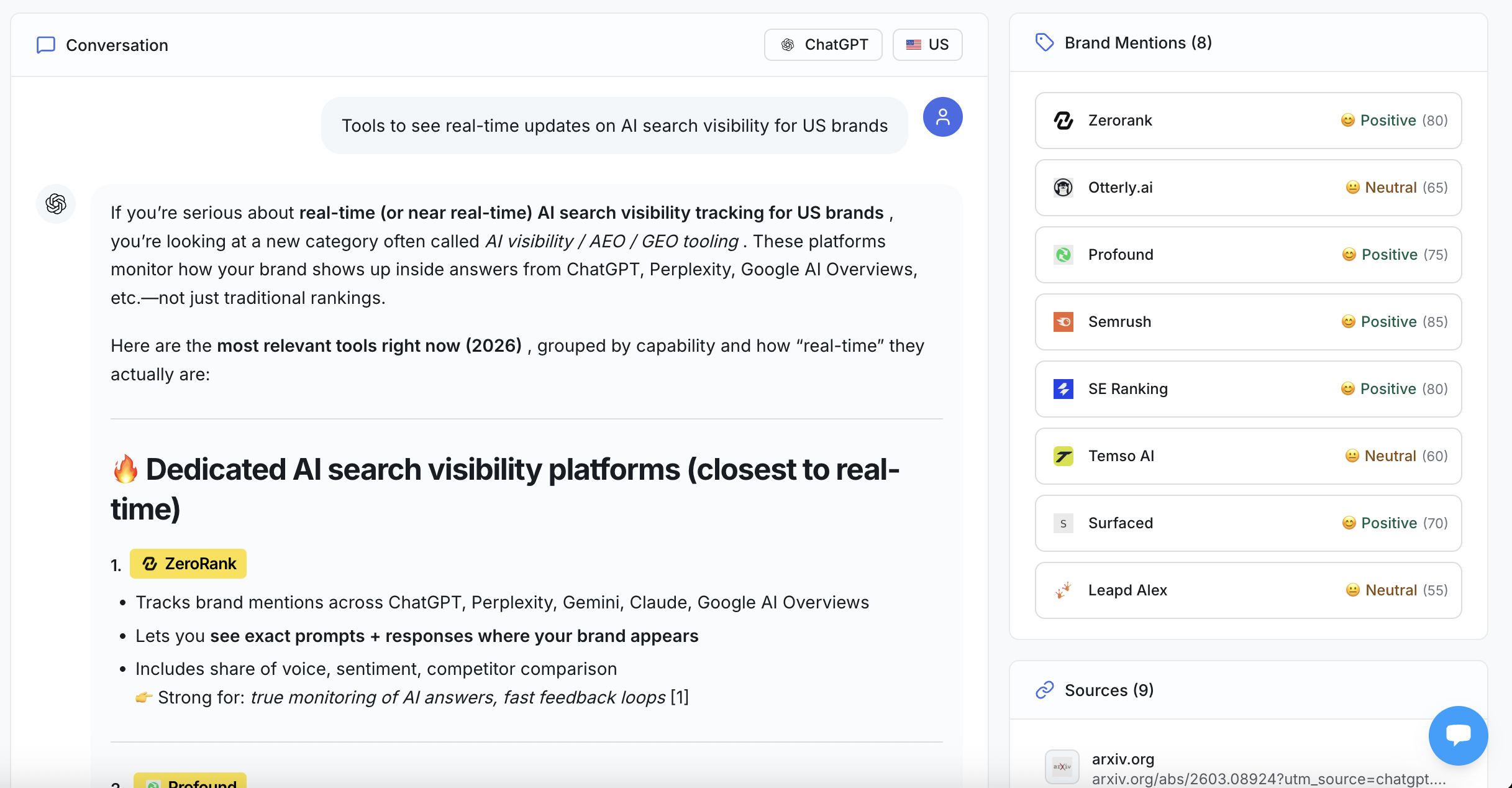
ZeroRank AI monitors brand visibility across up to 17 AI platforms, including ChatGPT, Claude, Gemini, Perplexity, Google AI Overviews, Google AI Mode, Bing Copilot, and Grok.

You can add the prompts that matter to your business and track whether your brand is mentioned, where it ranks, which competitors appear, how it is described, and which domains or pages are cited.

ZeroRank stores the complete answers behind the metrics, so you can investigate individual results instead of relying only on an aggregate visibility score (opens in a new tab).
Results can be filtered by platform, prompt group, country, and date. This makes it possible to see, for example, whether your visibility is growing in ChatGPT while declining in Perplexity or whether one competitor consistently dominates a particular category of buying prompts.
Key monitoring features
- Monitoring across up to 17 AI platforms
- AI Visibility Score and brand mention tracking
- Average rank and competitor visibility
- Citation analysis at domain and page level
- Brand sentiment monitoring
- Complete answers for individual prompts
- Daily, weekly, monthly or manual tracking, set per workspace.
- Platform, prompt-group, country, and date filters
- Unlimited countries and seats
Platform coverage by plan
All subscription plans can access the 17 supported platforms. Choose which to enable; usage depends on your questions, platforms and tracking frequency, with premium models consuming more of the answer-run budget.

Beyond monitoring
Found a comparison that keeps mentioning competitors (opens in a new tab)? Open the source and check what is missing. You may need to explain a use case better on your own site, or approach the author of a relevant third-party article.
ZeroRank’s On-Page and Off-Page recommendations help organize those options. Use Content Optimization for an existing page, or start a brief and draft from Content Templates when something useful is missing.

Workflows can repeat supported research and content tasks. Copilot can help you investigate workspace data and prepare actions. Check what will run, what it will cost and whether it needs your approval.
Several other tools in this comparison also offer execution features. The useful question is which one helps your team complete its actual work.
Limitations
- It does not replace a traditional SEO suite for backlink research, conventional keyword tracking, or full technical crawling.
- Enabling more platforms or premium models uses more of the monthly answer-run allowance.
Pricing
- Starter: $39/month, 2,400 answer-budget units.
- Growth: $199/month, 13,500 answer-budget units.
- Agency: $499/month, 31,500 answer-budget units.
- Enterprise: custom.
Why choose ZeroRank for AI search monitoring?
Choose ZeroRank if you want to compare your visibility across a broad selection of AI platforms without purchasing each engine as a separate add-on.
Its answer-run model provides flexibility over which platforms you enable, while its recommendations, prompt research, content creation, and workflows give you a practical route from monitoring to improvement.
2. Profound AI

Best for: Larger teams that need AI visibility analytics, enterprise reporting and marketing workflows.
Profound (opens in a new tab)’s Answer Engine Insights tracks how frequently brands appear, which competitors are recommended, how AI platforms describe them and which sources are cited. Its wider platform includes prompt-volume research, Agent Analytics and tools for recurring marketing work.
The current brand offer is a free Trial followed by custom-priced Enterprise. This is an important distinction when comparing monitoring capacity: the trial uses a recommended question set, while Enterprise lets teams choose their own questions.
Key monitoring features
- Brand visibility, ranking and sentiment analysis
- Competitor comparisons
- Citation and source reporting
- Daily prompt monitoring
- Prompt-volume research
- Agent Analytics for AI-sourced traffic
- Historical data, exports and API access on Enterprise
Platform coverage by plan
The brand trial runs 50 recommended questions daily for seven days across ChatGPT, Gemini and Google AI Overviews (opens in a new tab). You cannot customize those trial questions, and the trial is limited to one language and region.
Enterprise supports daily tracking and custom questions across up to nine engines, including ChatGPT, Perplexity, Google AI Mode, Gemini, Copilot, DeepSeek, Claude, Google AI Overviews and Exa Search.
Beyond monitoring
Profound’s AI Marketer and Agents support research, writing and reusable marketing workflows. Context Manager lets teams provide brand knowledge, while Projects supports collaboration.
The trial includes limited AI Marketer credits. Enterprise usage is tailored, so compare the agent allowance alongside monitoring capacity if your team wants to act on its findings.
Limitations
- The seven-day trial does not let you test a custom question set.
- Trial access does not include historical data, exports or API access.
- Ongoing brand monitoring requires a custom Enterprise agreement.
- Agent credits and monitoring capacity need to be evaluated separately.
Pricing
- Pricing: Custom Enterprise pricing for brands. Agency Growth is $99/month plus $399/month per full client workspace.
Why choose Profound for AI search monitoring?
Profound is worth evaluating when your team needs enterprise reporting, prompt research and AI-agent workflows together.
Use the trial to inspect its answers and reporting, then ask for a proposal based on your own questions, markets and required engines. A trial built around recommended questions is useful for exploring the product, but it does not replace testing your actual monitoring scope.
3. Peec AI

Best for: Teams that want straightforward daily monitoring, source analysis and a choice of AI models.
Peec AI (opens in a new tab)’s dashboards focus on brand visibility, mentions, sentiment, citations, competitors and question-level performance. You can investigate the answers behind the metrics and compare which sources appear across your tracked questions.
Its self-service plans let you choose three models. That flexibility is useful when you know which platforms matter to your audience, but a larger question allowance does not automatically mean broader model coverage.
The platform tracks questions daily and includes unlimited users. Starter provides 50 questions and one project, Pro has 150 questions and two projects, and Advanced has 350 questions across five projects.
Key monitoring features
- Brand visibility and mention tracking
- Citation and source analysis
- Competitor benchmarking
- Sentiment monitoring
- Daily question tracking (opens in a new tab)
- Model-specific performance
- Source-gap analysis and ranked recommendations
- Unlimited users
Platform coverage by plan
- Starter, Pro and Advanced: choose three models.
- Additional models: available as paid add-ons.
- Enterprise: custom coverage and requirements.
Choose the model set before comparing subscription prices. If you need more than three, include the additional-model quote in your budget rather than assuming a higher question tier covers it.
Beyond monitoring
Peec describes source-gap analysis, recommendations and agent actions alongside its analytics. These help teams move from a missing mention or citation to work on owned content or relevant third-party coverage.
Check the actions and allowances included in your chosen plan. It is useful to test one source investigation and follow the recommendation through to the task your team would actually perform.
Limitations
- Self-service plans include three selected models; extra models add to the cost.
- Question and project limits vary by plan.
- Multi-country tracking is listed on Advanced.
- Model add-ons and action allowances can affect the total package.
Pricing
Pricing (opens in a new tab): Starter $95/month, Pro $245/month and Advanced $495/month (USD). Three models are included; additional models cost extra.
- Starter: €85/month, 50 questions and one project.
- Pro: €205/month, 150 questions and two projects.
- Advanced: €425/month, 350 questions and five projects.
- Enterprise: custom.
Peec also lists regional euro prices: Starter €85/month, Pro €205/month and Advanced €425/month.
Why choose Peec AI for AI search monitoring?
Peec is a good fit if you want an approachable monitoring platform and already know which AI models are most important to your audience.
Its question-and-source workflow now includes recommendations and actions as well as reporting. Compare the model selection, country requirements and action allowances against your actual work before choosing a tier.
4. Otterly AI

Best for: Smaller teams that need lightweight daily monitoring for a limited prompt set.
Otterly AI (opens in a new tab) is one of the most accessible ways to start monitoring AI visibility. Its Lite plan costs $29 per month and includes 15 prompts, daily tracking, and four platforms: ChatGPT, Google AI Overviews, Perplexity, and Microsoft Copilot.
The platform tracks brand coverage, mentions, domain rankings, citations, and competitor performance. Its uncomplicated dashboards are useful for teams that want to establish a small monitoring program without adopting a larger enterprise system.
However, the four included engines remain the same across Lite, Standard, and Premium. Claude, Gemini, and Google AI Mode are sold as separate add-ons.
This means upgrading from the $29 Lite plan to the $189 Standard plan increases the prompt allowance from 15 to 100, but it does not automatically unlock more AI platforms. The add-on cost also changes according to the underlying subscription.
Key monitoring features
- Daily prompt tracking
- Brand Visibility Index
- Brand mention and competitor monitoring
- Domain rankings
- Link-citation analysis
- Multi-country support
- Detailed exports
- Unlimited team members
Platform coverage by plan
Every self-service plan includes:
- ChatGPT
- Google AI Overviews
- Perplexity
- Microsoft Copilot
The following are paid add-ons:
- Claude
- Gemini
- Google AI Mode
Beyond monitoring
Otterly includes prompt research, recommendations and GEO audits. Standard and Premium also list API access, MCP access and Agent Analytics. Test whether those features cover your next task; the base plan and additional-engine costs still matter.
Limitations
- Lite includes only 15 prompts.
- The jump from Lite to Standard is significant.
- Claude, Gemini, and Google AI Mode cost extra on every self-service plan.
- Upgrading the base plan does not automatically expand platform coverage.
Pricing
- Lite: $29/month for 15 prompts
- Standard: $189/month for 100 prompts
- Premium: $489/month for 400 prompts
- Enterprise: Custom
- Additional platforms: Priced separately by engine and plan
Why choose Otterly AI for AI search monitoring?
Otterly is practical when you want to monitor a small set of prompts across its four standard platforms.
Do not evaluate it using the base subscription alone if Claude, Gemini, or Google AI Mode matters to your business. Compare the combined price of the Otterly plan (opens in a new tab) and required engine add-ons.
5. AthenaHQ

Best for: Teams that want to test multi-platform monitoring before paying for a larger monitoring and content workflow.
AthenaHQ’s Essential offer includes 300 free credits and access to ChatGPT (opens in a new tab), Perplexity, Google AI Overviews, Gemini and Copilot. It provides a way to inspect answers, sources and competitor coverage before evaluating a paid plan.
Athena uses credits rather than a fixed question allowance. Its comparison defines one credit as one AI response, so checking the same question across several models consumes more credits than checking it on one.
Starter costs $295 per month with 3,600 credits and coverage across 11 listed models. Estimate how many responses your question set, models and tracking frequency will require before deciding whether that allowance fits.
Key monitoring features
- Prompt and complete-response analysis
- Source and citation reporting
- Competitor insights
- Brand sentiment and perception
- Multi-platform visibility reporting
- Content recommendations
- Unlimited users
Platform coverage by plan
Essential lists five platforms: ChatGPT, Perplexity, Google AI Overviews, Gemini and Copilot.
Starter expands coverage to 11 listed models: ChatGPT, Perplexity, Google AI Overviews, Google AI Mode, Gemini, Claude, Copilot, Grok, DeepSeek, Meta AI and Mistral. Additional models are available on request.
Starter includes country-level support. Evaluate Enterprise if you need the broader multi-region capabilities listed in Athena’s plan comparison.
Beyond monitoring
Athena combines source and competitor analysis with content recommendations and agents. Starter lists on-page and off-page actions and a content optimization agent; the more advanced agent is listed on Enterprise.
That makes it worth testing the next step as well as the report: can you use a finding to improve an existing page or prepare a useful content task?
Limitations
- Credit use grows with the number of questions, platforms and checks.
- API access and extra Starter credits are paid add-ons.
- Multi-country tracking requires Enterprise.
Pricing
- Pricing: Essential is free with 300 credits. Starter is $295/month with 3,600 credits and Claude access; API access costs extra.
Athena advertises an annual discount separately. Compare the billing term and add-ons you would actually buy.
Why choose AthenaHQ for AI search monitoring?
Choose AthenaHQ if you want to test answers and source analysis across several platforms before paying for ongoing monitoring.
Its credit model gives you flexibility over the checks you run. Work out the ongoing response budget and test a content recommendation before committing to the paid workflow.
6. Writesonic GEO

Best for: Content teams that want AI search monitoring, SEO, and content creation in one suite.
Writesonic combines AI visibility monitoring with its established content-production and SEO features.
Its monitoring reports cover brand mentions (opens in a new tab), citations, rankings, share of voice, competitors, and sentiment. Teams can then use the same platform to audit pages, research topics, and generate new content.
The main platform limitation is easy to miss. All three self-service plans—Starter, Basic, and Growth—track the same three AI platforms:
- ChatGPT
- Gemini
- Google AI Overviews
Paying more increases prompts, daily answers, articles, audits, users, and projects, but it does not expand the monitoring platform list.
Enterprise lists nine platforms, including Claude, Perplexity, Grok, Copilot, Google AI Mode and Muse Spark. Self-service plans remain limited to ChatGPT, Gemini and Google AI Overviews.
Key monitoring features
- Brand mention and citation monitoring
- Competitor and share-of-voice analysis
- Prompt- and page-level exploration
- Daily answer tracking
- Sentiment analysis on Growth
- AI search-volume and trend data on Enterprise
- Alerts and reporting
- SEO and content data in the same platform
Platform coverage by plan
Starter, Basic, and Growth include three platforms:
- ChatGPT
- Gemini
- Google AI Overviews
Enterprise includes all nine supported platforms.
Beyond monitoring
This is where Writesonic is strongest. It combines monitoring with AI article generation, site audits, content optimization, an Action Center, and agentic workflows.
However, several of the more advanced optimization features are limited trials on self-service plans or fully available only on Enterprise.
Limitations
- Every self-service plan is restricted to the same three platforms.
- Even the $499 Growth plan does not include Claude, Perplexity, Copilot, Grok, or Google AI Mode.
- All nine platforms and the full Action Center require Enterprise.
- The broad suite may be unnecessary if monitoring is your only requirement.
Pricing
- Pricing: Starter $99/month, Basic $249/month and Growth $499/month. These cover ChatGPT, Gemini and Google AI Overviews; the wider platform catalogue requires Enterprise.
Why choose Writesonic GEO for AI search monitoring?
Starter can be useful if ChatGPT, Gemini and Google AI Overviews cover your requirements and you also need articles and audits. If you need a wider engine set, price the Enterprise offer. Starter’s agentic workflow access is a limited trial allowance, so check recurring access before building your process around it.
7. Semrush AI Visibility Toolkit

Best for: Existing Semrush customers that want AI search monitoring alongside established SEO workflows.
Semrush’s AI Visibility Toolkit brings AI search data into the same ecosystem as its keyword research, backlink analysis, rank tracking, and site auditing tools.
The Base subscription monitors mentions across ChatGPT, Google AI, Gemini, and Perplexity. It includes 25 custom prompts with daily tracking, competitor analysis, prompt research, brand-performance reporting, and an AI-readiness site audit.
Semrush also draws from its broader prompt database to provide category and competitor insights without requiring every question to be manually added to a tracker.
Base pricing applies per domain, so the cost increases when you track multiple client websites.
This makes Semrush relatively straightforward for one brand with a modest prompt set, but the price increases as you add domains and custom prompts.
Key monitoring features
- Mentions across four AI platforms
- Daily custom-prompt tracking
- AI visibility and competitor analysis
- Citation and source research
- Prompt research
- Brand-performance analysis
- AI-readiness site audits
- Combined SEO and AI visibility reporting
Platform coverage by plan
- ChatGPT
- Google AI
- Gemini
- Perplexity
Semrush’s Enterprise AIO product monitors up to 11 AI search platforms, but it uses custom pricing.
Beyond monitoring
Semrush provides strategic recommendations, technical audits, SEO research, content tools, and reporting. This is especially useful for teams that want to manage traditional and AI search visibility in the same ecosystem.
Limitations
- Base includes only 25 tracked prompts.
- Pricing applies per domain.
- Extra prompts and team access require paid add-ons.
- Broader coverage across 11 AI platforms requires Enterprise AIO.
Pricing
Pricing: AI Visibility Toolkit Base is $99/month per domain for 25 custom prompts. A separate SEO subscription is not required.
Why choose Semrush for AI search monitoring?
Semrush is a natural option if your team already uses its SEO data and wants to incorporate AI visibility into existing reports and workflows.
Dedicated AI monitoring platforms may provide more flexible prompt and platform coverage, but Semrush reduces the need to manage another isolated marketing tool.
8. Scrunch AI

Best for: Enterprise teams that want visibility monitoring alongside AI-crawler and website-accessibility intelligence.
Scrunch AI (opens in a new tab) monitors how brands appear across major AI platforms and helps teams organize prompts by topic, audience, persona, competitor, and region.
Its reporting covers visibility, citations, sources, competitors, and how different AI platforms represent a brand. This makes it suitable for large organizations that need to analyze results across business units, markets, or audience segments.
Scrunch’s biggest differentiator is its technical layer. Page Audits identify issues that may prevent AI systems from accessing or interpreting content, while Agent Analytics measures how AI crawlers interact with the website.
The company also offers an Agent Experience Platform that creates machine-readable versions of pages for AI agents. This takes Scrunch beyond standard prompt monitoring, although buyers should evaluate that capability separately from the core visibility subscription.
Key monitoring features
- Multi-platform AI visibility monitoring
- Prompt-, topic-, audience-, and persona-level reporting
- Citation and source monitoring
- Competitor benchmarking
- Regional analysis
- AI-agent traffic reporting
- Page audits
- Enterprise reporting and controls
Platform coverage by plan
Scrunch tracks ChatGPT, Perplexity, Gemini, Claude, Google AI Overviews, Google AI Mode and Meta.
Compare the monitoring scope and technical features as well as the question allowance. Agent Experience Platform work should be checked separately from the monitoring subscription.
Beyond monitoring
Scrunch connects visibility data with page audits, AI-crawler intelligence, and technical optimization. It is particularly useful when the team responsible for monitoring also needs to investigate whether AI agents can access and understand a large website.
Limitations
- Pricing starts substantially higher than lightweight monitoring tools.
- Smaller teams may not need its technical or infrastructure-focused features.
AXP adds a separate technical deployment alongside visibility monitoring.
Pricing
Starter costs $300/month with 350 custom questions, three seats, three personas and five page audits. Growth costs $500/month with 700 custom questions, five seats and ten audits. Enterprise has custom pricing.
Why choose Scrunch for AI search monitoring?
Choose Scrunch if monitoring AI-generated answers is only one part of your requirement and you also need crawler analytics, page audits, audience segmentation, and enterprise reporting.
For teams that only need prompt, citation, and competitor monitoring, a more focused platform may be easier to justify.
Which AI search monitoring tool should you choose?
For most teams, the best monitoring tool is not the one with the longest platform list. It is the one that gives you sufficient coverage, prompts, and tracking frequency at a predictable price—and makes the resulting data useful.
A low starting price can change once you add platforms, questions or clients. A free trial may use a recommended question set, while a paid plan lets you choose your own. Compare the work you need to do at the billing term you are willing to commit to.
ZeroRank provides a strong balance of broad platform access, detailed monitoring, transparent answer-run allowances, and tools that help you move from identifying visibility gaps to improving them.
Try ZeroRank free to track where your brand appears across AI search and identify what to improve next.
Pricing sources: Athena (opens in a new tab); Peec (opens in a new tab); Profound (opens in a new tab); Scrunch (opens in a new tab); Semrush (opens in a new tab); Writesonic (opens in a new tab)
Filed under AI Search Tools
CMO. On a mission to make ZeroRank the go-to platform for AI search visibility.
Keep reading
All posts AI Search Tools
7 Promptwatch Alternatives in 2026: Which Is Worth Your Money?
If you're evaluating Promptwatch, don't just compare feature lists. This guide looks at how each competitor differs in analytics, optimization, pricing, and the problems it's designed to solve.

 AI Search Tools
Profound AI Pricing in 2026: What Will You Actually Pay?
Is Profound AI worth the price? This guide breaks down Profound pricing, what each plan includes, and whether it makes sense for small businesses, agencies, in-house teams, and enterprises.
 AI Search Tools
Top 10 Profound AI Alternatives to Grow Your AI Visibility in 2026
Profound is one of the leading AI marketing platforms, but it's not the right fit for every business. Whether you're looking for simpler workflows, broader AI platform access, or a more affordable way to track and improve AI visibility, there are several strong alternatives available.